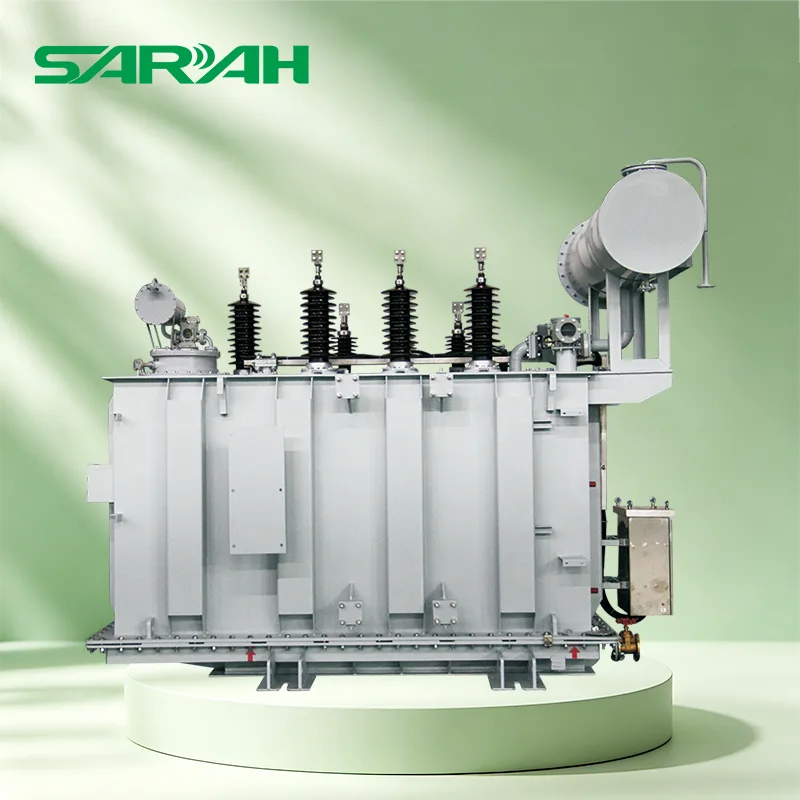
110KV Power Transformer 20000KVA
Sarah Electric is a reliable manufacturer of 110KV Power Transformer 20000KVA, backed by over 20 years of experience and robust capabilities in R&D, production, and supply. Suitable for industrial applications, urban power distribution networks, and new energy projects, these transformers offer ease of installation and maintenance, with customization options available to meet specific project requirements.
Sarah Electric offers high-quality 110KV Power Transformer 20000KVA capable of stepping down voltage from 110kV to levels such as 10kV or 35kV. These high-capacity units support continuous, long-term operation and feature a design lifespan of over 30 years.
What Is a 110KV Power Transformer 20000KVA?
A 110kV, 20,000kVA (or 20MVA) power transformer is a unit featuring a rated high-side voltage of 110kV and a rated capacity of 20,000kVA. These two key specifications signify the following:
1. 110kV
110kV is a well-established voltage level for backbone power transmission and high-voltage distribution in many countries and regions worldwide, particularly within power grids adhering to IEC or GB standards.
This power transformer steps down the 110kV high voltage to 35kV or 10kV/11kV to supply power to urban distribution networks, large commercial complexes, or major heavy industrial plants.
2. 20,000kVA
This rated capacity is sufficient to meet the full-load electricity demands of the core area of a medium-sized county town, a large-scale integrated commercial complex, or a large heavy industrial plant.
Structural Components
● Core & Windings: Constructed using high-permeability grain-oriented silicon steel sheets and high-purity oxygen-free copper windings; these form the core assembly responsible for electromagnetic induction and voltage transformation.
● Transformer Oil & Tank: The transformer oil serves as both an insulating medium and a heat-dissipation medium.
● HV Bushings: Long insulating porcelain or composite bushings extending from the top, used to safely bring out the 110kV high-voltage lines.
● Cooling System: Equipped with cooling fins and fans; utilizes ONAN (Oil Natural Air Natural) or ONAF (Oil Natural Air Forced) cooling methods.
● Tap Changer: Used to regulate and stabilize the output voltage. Options include On-Load Tap Changer (OLTC)—capable of automatic voltage adjustment while under load—or No-Load Tap Changer (NLTC).
● Safety and Protection Components: Buchholz relay, pressure relief valve, dehydrating breather, and substation-class surge arrester.
Technical Specifications
|
Parameters |
Typical Value/Range |
|
Rated capacity |
20,000 kVA (20 MVA) |
|
High-voltage side voltage |
110 kV (±8 × 1.25% on-load tap changing) |
|
Low-voltage side voltage |
35 kV / 10.5 kV / 6.3 kV (customizable upon request) |
|
Number of phases |
Three-phase |
|
Cooling method |
ONAN (oil-immersed self-cooled) or ONAF (oil-immersed forced-air cooled) |
|
Vector group |
YNd11 (most common) |
|
Short-circuit impedance |
Approx. 10.5% ~ 17% |
|
No-load loss |
Approx. 15 ~ 25 kW |
|
Load loss |
Approx. 80 ~ 110 kW |
|
Insulation level |
Lightning impulse withstand voltage approx. 480 kV; power frequency withstand voltage approx. 200 kV |
Application Scenarios
1. 110kV Substations
Typical Structure: 110kV transmission line → 110kV power transformer → 10kV/35kV distribution system → User load
Function: Steps down the 110kV voltage from the regional transmission grid to distribution voltage levels, providing a stable power supply to urban and industrial areas.
Applications: Urban substations, regional substations, dedicated industrial substations, etc.
2. Industrial Park Power Supply
Typical Structure: 110kV grid → 20MVA transformer → 10kV factory distribution → Production equipment
Function: Meets the demands of high-power equipment and mitigates the impact of power supply fluctuations.
Applications: Independent high-voltage power supply systems for sectors such as steel manufacturing, chemical production, cement plants, mining enterprises, automotive manufacturing, and machining bases.
3. New Energy Power Generation Projects
Typical Structure: PV panels → Inverter → 35kV collection system → 110kV transformer → Grid connection
Function: Steps up medium-voltage power generated by sources (such as photovoltaics) to meet grid connection requirements.
Applications: Photovoltaic power plants, wind farms, wind turbine collection lines, etc.
4. Urban Grid Expansion and Upgrading
Function: Optimizes grid structure and increases regional power supply capacity to keep pace with growing urban electricity demand.
Applications: New urban district development, commercial center power supply, high-density residential areas, urban infrastructure, etc.
5. Power Supply for Large-Scale Buildings and Infrastructure
Function: Ensures continuous power supply, stable loads, and high power quality.
Applications: Airports, high-speed railway stations, data centers, large hospitals, ports, logistics parks, etc.
6. Power Supply for Mining and Remote Areas
Function: Establishes independent power networks for areas far from urban grids, providing stable, high-capacity power while reducing losses associated with long-distance low-voltage transmission.
Applications: Mining areas, oil and gas projects, remote industrial bases, etc.
110KV Power Transformer 20000KVA vs. Distribution Transformer: What's the Difference?
|
Item |
110kV Power Transformer |
Distribution Transformer |
|
Voltage Class |
110kV |
Typically ≤35 kV |
|
Capacity |
MVA level |
kVA to MVA |
|
Application |
Power grid, substation |
End-user power distribution |
|
Structure |
Complex |
Relatively simple |
|
Voltage Regulation |
OLTC compatible |
Mostly off-load tap changing |
|
Investment |
High |
Lower |
● 110kV Power Transformer: Used for voltage transformation between transmission networks and large-scale distribution systems; classified as grid-level equipment.
● Distribution Transformer: Used to step down voltage for end-user power supply; classified as terminal distribution equipment.
FAQ
Q1: What scale of power demand can a 110KV Power Transformer 20000KVA satisfy?
A:
1. Urban Distribution Networks: It can meet the peak daily electricity demand of approximately 15, 000 to 25, 000 ordinary residential households.
2. New Energy Generation: It can support a 20MW-class centralized photovoltaic (PV) power plant or a medium-sized onshore wind farm.
3. Industrial/Commercial: It can support the continuous full-load operation of a medium-sized steel mill or chemical plant, a large comprehensive shopping mall, or a medium-sized data center.
Q2: What high-voltage lightning protection and safety equipment is required for the high-voltage and low-voltage sides of this transformer?
A:
1. High-Voltage Side (110kV): A substation-class surge arrester is mandatory; the use of a surge counter (or online leakage current monitor) and a grading ring is also recommended.
2. Low-Voltage Side (35kV / 10kV / 11kV): Depending on the feeder configuration, substation-class or distribution-class surge arresters should be installed. Additionally, a Buchholz relay and a pressure relief valve should be equipped to provide secondary relay protection against internal faults.
Q3: Can Sarah Electric provide the Type Test Report for this transformer?
A: Yes, we fully support compliance and market entry requirements.
Our 110kV-class transformers are designed and manufactured in strict accordance with IEC 60076 and IEEE C57 international standards. We can provide overseas EPC contractors and utility companies with comprehensive type test reports issued by independent third-party laboratories (covering lightning impulse tests, temperature rise tests, short-circuit withstand tests, and partial discharge tests).

Send Inquiry
Contact Info
-
Address
No.101-103, Fu Hua Road, Leshang Chuangye Yuan, Wengyang Industrial Zone, Yueqing, Wenzhou, Zhejiang, China
-
Tel
-
Email
For inquiries about electrical transformer, surge arrester, fuse cutout or price list, please leave your email to us and we will be in touch within 24 hours.



News Recommendations